How to Light Your House for Halloween: UK Guide 2026
Quick answer: how do you plan Halloween lighting for your house?
Build it in three layers: a welcome light at the door so visitors can see the step, accent light on one or two props, and an effect light such as colour or flicker for atmosphere. Choose the power source by location (battery for pumpkins, plug-in for porches, a low-voltage driver for strips), keep everything weather-protected, and put it all on a timer.
In this guide
- The three-layer lighting plan
- Lighting ideas for your type of home
- How bright should Halloween lights be?
- Colour temperature for candle and ghost glows
- Battery, plug-in or low-voltage?
- Weatherproofing for UK October weather
- How to create a flickering flame effect
- Projects by time: 10 minutes to a weekend
- Lighting a Halloween party indoors
- Spooky without upsetting the neighbours
- What to do with your lights after Halloween
- Shop the lighting
- FAQs
What is the three-layer Halloween lighting plan?
Most displays look chaotic because every light is doing the same job. Splitting your lighting into three layers gives each one a purpose, and means you can spend where it counts and keep the rest simple.
| Layer | Its job | Examples |
|---|---|---|
| Welcome | Lets visitors see steps, the doorbell and the path | A warm porch light, low path lights, an outdoor wall light |
| Accent | Draws the eye to your best prop | An uplight on a scarecrow, a spotlight on a hanging prop, backlit window cut-outs |
| Effect | Creates the mood | Colour-changing strips, flicker bulbs, projected patterns, coloured bulbs |

Rule of thumb: if you can only afford one layer this year, make it the welcome layer. A well-lit front step is the difference between a fun doorstep and a trip hazard.
What Halloween lighting works for your type of home?
The best setup depends on what you can attach, plug in and drill. This table matches common UK homes to the approach that works.
| Home type | Best approach | Watch out for |
|---|---|---|
| Terraced or semi with a small front step | One strong focal point by the door, lit pumpkins on the step, warm light overhead | Cables across a shared path or pavement |
| Flat or apartment | Backlit window cut-outs, battery or USB lights, a coloured bulb in a window lamp | Communal-area rules, no mains outdoors |
| Detached house with a garden | Uplit trees, a lit driveway edge, a coloured wash on the front wall | Needs weather-rated power and an RCD |
| Rented home, no drilling | Plug-in lights, adhesive hooks, freestanding lanterns, plug-in lighting | Check what your tenancy allows before fixing anything |
How bright should Halloween lights be for trick-or-treaters?
Bright enough to see the step and the door, dim enough to keep the mood. As a rough guide, aim for a few hundred lumens in total around the doorway, and keep individual decorative lights low. Brightness is measured in lumens, and it is printed on the bulb or box.
| Area | Rough brightness | Why |
|---|---|---|
| Front door and step | About 300 to 800 lumens in total | Visitors need to read the step edge and find the bell |
| Path lights (each) | About 20 to 100 lumens | Marks the route without glare |
| Pumpkin or lantern interiors | Under about 100 lumens | Soft glow reads better than a bright bulb |
| Spotlight on a prop | About 200 to 500 lumens | Enough contrast against the dark background |
These are practical guide figures, not regulations. Aim spotlights downward or away from the street so they do not dazzle visitors or passing drivers.
Does a lit porch light mean trick-or-treaters are welcome?
By common convention, yes: a lit porch or a glowing pumpkin signals that you are happy to receive visitors, and a dark house signals you are not. It is an informal custom rather than a rule, so if you do not want callers, simply leave the front light off.
What colour temperature is best for a pumpkin or candle glow?
For a pumpkin or candle look, choose an amber or warm white bulb of about 1800K to 2700K. Colour temperature is measured in kelvins: lower numbers look warmer and more orange, higher numbers look whiter and bluer. Real candle flame sits around 1800K to 2000K.
| Look you want | Colour temperature | Use it for |
|---|---|---|
| Candle or ember glow | About 1800K to 2200K (amber) | Pumpkins, lanterns, mantelpiece displays |
| Cosy warm white | About 2700K | Porch lights, living room lamps |
| Moonlight or ghostly | About 5000K to 6500K (cool white) | Uplit trees, window silhouettes, graveyard scenes |
| Supernatural | Coloured: purple, green, blue | Washes, projections, party corners |

Do coloured LED bulbs use more electricity? No. A coloured LED bulb uses the wattage printed on its packaging, the same as a white LED of the same rating. Browse energy-saving LED bulbs for efficient options.
Should you use battery, plug-in or low-voltage Halloween lights?
Use battery lights for pumpkins and anywhere without a socket, plug-in lights for porches and living rooms, and low-voltage systems for long runs of strip lighting. Each has trade-offs.
| Power source | Best for | Pros | Cons |
|---|---|---|---|
| Battery | Pumpkins, lanterns, small props | No cables, place anywhere | Batteries run out; cold weather shortens life |
| Plug-in mains | Porches, windows, rooms | Consistent brightness, easy with a timer | Needs a safe socket route; outdoor use needs rated products and an RCD |
| Low-voltage (12V or 24V) with a driver | LED strips, long outlines, bigger displays | Safer low-voltage output at the lights, flexible lengths | Driver must be sized and weather-protected |
How do you size a low-voltage LED driver?
- Add up the wattage of everything on the circuit (for example 5m of strip at 14W per metre is 70W).
- Add about 20% headroom, so choose a driver of roughly 85W to 100W in this example.
- Match the voltage: see 12V transformers or 24V transformers.
- For outdoor use, pick a driver with a suitable IP rating, such as an IP67 waterproof driver or an IP45 rainproof driver in a sheltered spot.
Unsure which parts you need? Use the product configurator or the installation guide.
How do you weatherproof Halloween lights for UK October weather?
Keep every connection dry and off the ground, choose products rated for outdoor use, and protect mains-powered lights with a 30mA RCD. October in the UK means rain, wind and damp air, and most failures happen at connections, not at the lights themselves.
- Make a drip loop: let the cable hang in a low U-shape before it reaches a plug or connector so water drips off instead of running in.
- Lift connections off the floor: puddles form where plugs and connectors sit on paving. Raise them on a dry bracket or hook.
- Match the rating to the position: IP44 is a sensible minimum for sheltered outdoor lights, and IP65 or higher for ground-level lights and strips.
- Secure against wind: use clips or outdoor ties on lines and props, as loose cables swing and pull on connections.
- Expect condensation: bring battery packs and sensitive props indoors on wet nights, and leave sealed fittings to dry before reuse.
- Use proper connectors: see wire connectors and junction boxes, and our guide to common wiring mistakes. Use a qualified electrician for fixed outdoor wiring.
How do you create a flickering flame effect with LED lights?
The simplest options are flameless LED candles with a flicker mode, amber filament bulbs on a dimmer, or smart bulbs set to a candle scene. They give the movement of a flame without heat, smoke or open fire risk.
- Flameless candles: group three to five at different heights for a more natural, uneven flicker.
- Dimmed filament bulbs: an amber bulb run at low brightness reads like a lantern. Use dimmable LED bulbs and check that your dimmer is LED-compatible.
- Enclosed lanterns: check the lantern's maximum bulb wattage and ventilation. A low-wattage LED is usually fine where an old incandescent would not be.

Which Halloween lighting projects can you finish in 10 minutes, an hour or a weekend?
10 minutes
- Swap one lamp bulb for an orange or purple one. Check the fitting first: E27, B22 or E14.
- Put battery lights in carved pumpkins and set them on the front step.
- Tape card cut-outs to a window and place a lamp behind them.
One hour
- Run a plug-in string along the porch or fence and fit a timer.
- Use a coloured strip behind a mirror, shelf or sideboard for an indoor glow.
- Build a lantern cluster of three or four with warm LED bulbs.
A weekend
- Create a full low-voltage outline of the house using a waterproof RGB strip and a sized driver.
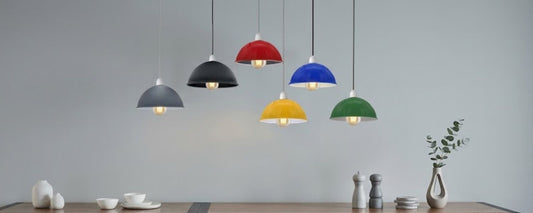
- Hang a spider pendant light in a hallway or porch (a multi-arm pendant that throws web-like shadows) and fit it with coloured bulbs.
- Build a themed scene, such as a graveyard or a witch's cottage, with one focal prop and one coloured wash.

How do you light a Halloween party indoors?
Dim the main lights, add two or three low coloured sources in corners, and keep one clear, brighter area for food and drinks. Parties go wrong when the whole room is dark, so light by zone.
- Entrance: a warm, steady light so guests can see where to hang coats and step in.
- Food and drink: one brighter, warm zone so people can see what they are eating.
- Mood corners: purple or green bulbs in lamps, or a strip behind furniture.
- Ceiling feature: a pendant, such as a pendant light with coloured bulbs, to set the tone overhead.
- Control: dimmers or a smart plug so you can change the mood in one tap.
How do you do spooky lighting without upsetting the neighbours?
- Set a curfew: a timer that switches off around 10 or 11pm keeps energy use and light spill down.
- Aim lights down and inward: keep beams off windows and out of the road.
- Avoid strobes: flashing and strobe effects can trigger seizures in people with photosensitive epilepsy, so choose slow fades and steady glows instead.
- Keep it clear of shared space: do not trail cables across pavements or shared paths.
What can you do with Halloween lights afterwards?
Most of your lighting can be reused: amber bulbs and lanterns suit Bonfire Night and autumn evenings, and low-voltage drivers and strips carry straight into Christmas displays. Store them properly and they will last for years.
- Coil cables loosely and label each driver with its voltage and wattage.
- Keep bulbs in their boxes, marked with the fitting type.
- Wipe condensation off fittings and let them dry fully before packing.
- Swap coloured bulbs for warm white and reuse the same fittings for winter.
Shop the lighting

Vintage LED Filament Bulb, 4W E27
A low, amber glow for pumpkins, lanterns and candle-style scenes.
View product
Modern Spider Ceiling Light
A multi-arm centrepiece for hallways, bars and party rooms that works all year.
View product
E27 Heart LED Bulb, 4W
A shaped filament bulb for accent lighting and decorative shadows.
View productAlso browse: LED bulbs | spider lights | IP67 drivers | outdoor wall lights | plug-in lights | lighting accessories
Ordering close to the date? Check delivery information for next-day express options.
Halloween lighting FAQs
How do I plan Halloween lighting for my house?
Plan three layers: a welcome light at the door, accent light on one or two props, and effect light such as colour or flicker. Choose battery, plug-in or low-voltage power for each area, weatherproof the connections and add a timer.
How bright should Halloween lights be for trick-or-treaters?
Aim for a few hundred lumens in total around the front door so visitors can see the step, and keep decorative lights low, with path lights around 20 to 100 lumens each. These are practical guide figures.
What colour temperature is best for a pumpkin glow?
Amber or warm white of about 1800K to 2700K. Lower kelvin numbers look warmer and closer to candle flame.
Should I use battery, plug-in or low-voltage Halloween lights?
Battery for pumpkins and places with no socket, plug-in for porches and rooms, and low-voltage with a correctly sized driver for strips and larger displays.
How do I weatherproof Halloween lights in the UK?
Use outdoor-rated products with an appropriate IP rating, make drip loops in cables, lift connections off the ground, secure everything against wind and protect mains-powered lights with a 30mA RCD.
How do I make a flickering flame effect with LEDs?
Use flameless LED candles with a flicker mode, or amber dimmable filament bulbs run at low brightness, giving a flame-like glow without heat or open fire risk.
What Halloween lighting can I use in a flat or rented home?
Battery or USB lights, plug-in lamps with coloured bulbs, backlit window cut-outs and adhesive hooks. Check your tenancy before fixing anything.
Do coloured LED bulbs use more electricity?
No. A coloured LED bulb uses the wattage on its packaging, the same as a white LED of the same rating.
Are strobe lights safe for Halloween?
Avoid them. Flashing and strobe effects can trigger seizures in people with photosensitive epilepsy. Use slow fades and steady glows instead.
What do I do with Halloween lights afterwards?
Reuse them for Bonfire Night, autumn and Christmas. Store cables coiled loosely, label drivers by voltage, keep bulbs in marked boxes and dry everything fully before packing.
Plan it once, reuse it all season
Start with a lit front step, add one strong accent and finish with a single effect. Then browse LED bulbs, spider lights and LED transformers to be ready for 31 October.
Labels: