Steampunk & Pipe Lighting Ideas for Industrial-Style Homes 2026
Walk into any design-forward home this year and you'll spot it fast: exposed bulbs, black iron pipe fixtures, and a warm amber glow that feels equal parts Victorian workshop and modern loft. That's steampunk lighting — and in 2026 it has moved firmly from niche aesthetic to mainstream UK interior trend.
At LEDSone, we've watched demand for pipe lighting and conduit lighting components climb steadily as homeowners move away from flat, minimalist fittings toward fixtures with visible character — raw metal, exposed hardware, and bulbs that are meant to be seen, not hidden. This guide breaks down exactly what steampunk lighting is, why it's trending, how to bring it into every room of your home, the mistakes to avoid, and a buying checklist to run through before you order anything.
What Is Steampunk Lighting?
Steampunk lighting blends Victorian-era industrial design with modern electrical fittings. Think brass fixtures, black iron pipework, exposed conduit runs, and filament bulbs left fully visible rather than shaded or diffused. The style borrows heavily from 19th-century factories, railway stations, and workshops — spaces where the mechanics of a light fitting were never hidden, they were the design itself.
Unlike generic industrial pendant lights, true steampunk fixtures lean into visible engineering: threaded pipe joints, brass valve-style switches, knurled dimmer knobs, and cage guards around the bulb. It's a maximalist take on industrial style — more ornate, more tactile, and more of a statement piece than a plain black pendant.
The core materials repeated across steampunk fixtures:
- Blackened or raw brass pipework
- Cast iron pipe fittings and flanges
- Exposed fabric-braided cable
- Wire cage bulb guards
- Edison-style filament bulbs
If you're building this look from scratch, our Conduit Lighting collection is a good starting point for the raw pipework and fittings that anchor the style, paired with fabric cables for the exposed wiring runs.


Why Pipe & Conduit Lighting Is Dominating Interior Trends in 2026
A few things are driving this trend beyond simple aesthetics:
1. The shift away from "builder-grade" minimalism. After nearly a decade of flush ceiling spots and matte white pendants, homeowners are actively seeking fixtures with texture and story. Pipe lighting delivers instant visual interest without requiring a full renovation — a single fixture change can transform a room's character far more cheaply than replastering or reflooring.
2. Rise of loft-style renovations and converted spaces. Barn conversions, warehouse flats, and garden studios suit exposed conduit lighting far better than delicate glass fittings. The raw materials complement brick, concrete, and reclaimed wood finishes already common in these spaces, and they hold up visually against high ceilings and open-plan layouts where smaller fittings would look lost.
3. Social platforms rewarding "statement" lighting. Pinterest and Instagram searches for industrial and steampunk interiors have grown consistently — a single striking pendant cluster photographs better than a recessed downlight ever will, and homeowners are increasingly choosing fixtures with social sharing in mind.
4. Modular, DIY-friendly components. Unlike fixed designer pendants, pipe-and-fitting systems let you build custom lengths and configurations using standard threaded connectors — appealing to the growing DIY lighting market and giving buyers a level of customisation that off-the-shelf fittings can't match.
5. Sustainability and repair culture. Steampunk fixtures are built from durable, repairable materials — metal pipework and standard bulb fittings rather than sealed, disposable units. As buyers become more conscious of repairability, fixtures that can be disassembled, cleaned, and re-wired rather than binned have an added appeal.


Key Elements of Steampunk Lighting Design
Before you buy anything, it helps to understand the building blocks. A well-executed steampunk or industrial pipe fixture typically combines:
Metal Finish
Blackened iron, aged brass, and raw unlacquered copper are the three dominant finishes. Aged brass pairs well with warmer colour schemes; blackened iron suits cooler, more minimal industrial spaces. Raw copper develops a natural patina over time, which some buyers actively seek out as part of the aesthetic rather than avoid.
Threaded pipe in varying diameters, combined with elbow joints, T-fittings, and flanges, lets you build anything from a simple wall sconce to a multi-arm ceiling cluster. This is where conduit lighting components do double duty — functional wiring conduit that's also the visible design feature. Standard pipe diameters (typically 15mm–20mm for domestic use) keep fittings compatible across brands, which matters if you're planning to expand a fixture later.
The bulb is the centrepiece, not an afterthought. Exposed Edison bulb fixtures with visible filament coils are non-negotiable for authentic steampunk style — more on bulb selection below.
Fabric-braided cable in black, brown, or twisted two-tone finishes replaces standard white flex, reinforcing the vintage-industrial feel even where cable is visible by design. Twisted two-core fabric cable is particularly popular for pendant drops because the texture is visible even from a distance.
Brass toggle switches, rotary dimmers, and valve-handle style controls finish the look — small details, but ones that separate a genuine steampunk fixture from a generic black pendant. A mismatched plastic switch plate next to an otherwise well-executed pipe fixture is one of the fastest ways to undercut the whole design.
7 Steampunk & Pipe Lighting Ideas by Room
1. Living Room: Pendant Clusters Over a Coffee Table or Sofa
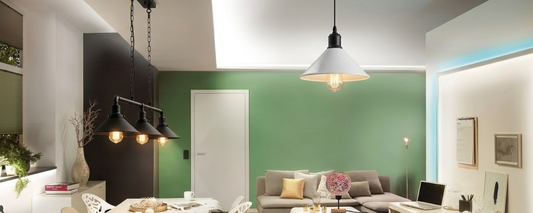
A cluster of three to five staggered-height pendants, each on individual fabric cable drops, creates a strong focal point above a coffee table or reading corner. Mix pipe lengths for an asymmetrical, hand-built look rather than a symmetrical chandelier arrangement. Keep the cluster centred over furniture rather than the room's geometric centre — it should relate to where people sit, not to the ceiling rose position. For rooms with standard 2.4m ceilings, keep the lowest bulb at least 1.9m from the floor to avoid it becoming a walking hazard near seating.
2. Kitchen Island: Pipe-Mounted Pendant Lights
Kitchens are one of the best places to commit fully to pipe lighting — the material tolerates kitchen wear well, and a row of two or three matching pendants over an island reads as intentional design rather than an afterthought. Pair with dimmable Edison bulb fixtures for flexible task-to-ambient lighting. Space pendants evenly along the island's length, typically 60–75cm apart, and hang them so the bulb sits roughly 75–80cm above the worktop to avoid glare while still lighting the surface properly.
3. Bedroom: Wall-Mounted Pipe Sconces
Swap bedside table lamps for wall-mounted pipe sconces with an adjustable arm. This frees up nightstand space and adds an architectural element to the wall itself — particularly effective against exposed brick or dark painted feature walls. An articulated pipe joint lets the fixture double as a reading light by day and ambient wash lighting by night, which matters more in bedrooms than almost any other room.
4. Hallway: Exposed Conduit Runs
Hallways are an underused opportunity for conduit lighting. A horizontal or vertical conduit run with two or three branch fittings turns a purely functional space into a design feature, especially in narrow hallways where wall-mounted fixtures work better than pendants. Running the conduit along a single wall at picture-rail height avoids clutter at eye level while still providing enough general illumination for a transitional space.
5. Home Office: Articulated Pipe Desk Lamps
A pipe-jointed desk lamp with an exposed bulb brings the steampunk aesthetic to a work-from-home setup without overwhelming the space. Look for adjustable joints so the fixture doubles as functional task lighting — a fixed-angle decorative lamp looks the part but quickly becomes impractical for actual desk work, so prioritise fixtures with genuine articulation over ones that are purely ornamental.
6. Bathroom: IP-Rated Industrial Fittings
Steampunk style can work in bathrooms, but only with fixtures rated for damp environments. Always check the IP rating before installing pipe-style fittings near a shower or bath zone — this is one area where authenticity has to yield to safety. Standard decorative pipe fixtures with exposed brass contacts are not suitable for Zone 1 or Zone 2 bathroom areas; save the fully exposed look for a mirror-side sconce well outside the splash zone instead.
7. Garden & Outdoor Spaces: Weatherproof Pipe Lighting
Black iron pipe fixtures suit garden bars, outdoor kitchens, and pergolas particularly well. Choose fittings rated IP44 or higher, and pair with a suitable outdoor-rated transformer if running low-voltage LED. For pergola or gazebo installations, running the conduit along existing structural beams keeps wiring protected from weather while reinforcing the industrial look rather than fighting against the outdoor setting.


Choosing the Right Bulb for Steampunk Fixtures
The bulb makes or breaks a steampunk fixture, since it's fully exposed rather than shaded.
Edison filament bulbs are the standard choice — the visible spiral or squirrel-cage filament is the whole point of the aesthetic. When choosing between options, consider:
- Warm white (2200K–2700K): Gives the classic amber "vintage glow." Best for living rooms and bedrooms. Anything above 3000K starts to look clinical against raw metal fittings and works against the aesthetic.
- Dimmable vs non-dimmable: Always choose dimmable if the fixture will be on a dimmer circuit — non-dimmable LED filament bulbs can flicker or buzz on dimming controls, which undermines an otherwise well-built fixture.
- Bulb shape: ST64 and G95 globe shapes are the most popular for steampunk fixtures because the filament is more visible than in a standard A60 shape. Larger globe shapes (G125, G200) work well as single statement bulbs in minimal pendant designs.
- Base fitting: Most UK steampunk fixtures use E27 fittings, though smaller decorative pieces sometimes use E14. Always confirm which fitting your chosen holder takes before ordering bulbs — this is one of the most common return reasons on decorative lighting.
- Wattage equivalence: LED filament bulbs typically use 4–8W to replicate the light output of older 40–60W incandescent bulbs. Check lumen output rather than wattage alone when comparing options, since filament styles vary in efficiency.
Wiring & Transformer Considerations for Pipe Lighting
This is where steampunk lighting projects most often go wrong — the aesthetic is DIY-friendly, but the electrics still need to be done properly.
Mains vs low-voltage: Most pendant and wall sconce Edison-bulb fixtures run directly on mains voltage (240V) and don't require a transformer. However, if you're incorporating LED strip accents into a pipe fixture — for example, uplighting inside a pipe frame — you'll likely need a 12V or 24V LED transformer to step the voltage down safely.
Matching transformer to load: Undersized transformers are one of the most common mistakes in custom lighting builds. Always total the wattage of everything connected and choose a transformer rated with at least 20% headroom above that figure, both for reliability and to avoid overheating over long-term use.
Outdoor installations: Any pipe lighting installed outdoors — garden runs, pergolas, outdoor bars — needs an IP-rated transformer, not a standard indoor unit, even if the fixture itself is weatherproof. A weatherproof fixture connected to an indoor-rated transformer left exposed to the elements is still a safety risk.
Cable rating: Fabric-braided cable used for exposed runs must still meet current UK wiring regulations for the load it's carrying. Decorative cable that isn't rated for the bulb wattage is a fire risk — don't treat it as purely cosmetic, regardless of how well it matches the finish of the rest of the fixture.
Earthing and metal fixtures: Because steampunk fixtures are predominantly metal, correct earthing is essential. Any fault in the wiring can make an exposed metal pipe fixture live, so this is not an area to shortcut on a DIY build.
If you're unsure which transformer or cable spec suits your project, it's worth checking product specifications carefully before buying, or consulting a qualified electrician for anything beyond simple bulb-and-holder pendant installs.
Common Mistakes to Avoid
Mixing too many metal finishes. The single fastest way to make a steampunk scheme look unplanned is combining blackened iron, brass, and chrome fittings in the same room. Pick one dominant finish and treat any additional metal as a deliberate accent, not a second competing theme.
Ignoring bulb glare. Fully exposed filament bulbs look striking in photos but can be genuinely uncomfortable at eye level in daily use. Position fixtures so the bulb isn't in direct sightline from a seated position, or use dimmable bulbs to manage brightness through the evening.
Underestimating fixture weight. Cast iron pipework and fittings are significantly heavier than standard lighting fixtures. Ceiling fixings need to be rated for the actual weight of the assembled fixture, not just the ceiling rose's default fixing — this is especially important for multi-arm cluster pendants.
Treating decorative cable as purely cosmetic. As covered above, fabric-braided cable still has to meet the electrical rating for the load it carries. Buying cable purely on colour match without checking the rating is a genuine safety issue, not just a design oversight.
Skipping the dimmer. Steampunk fixtures are usually installed as statement pieces, but statement lighting at full brightness all evening quickly becomes fatiguing. A dimmer switch is one of the cheapest additions that makes the biggest difference to how usable the fixture actually is.
Going too matchy across the whole house. Steampunk works best as a considered style in specific rooms — kitchen, hallway, home office — rather than applied uniformly throughout a home. Overuse flattens the impact that makes the style distinctive in the first place.
How to Style Steampunk Lighting Without Overdoing It
The biggest risk with steampunk and industrial pipe lighting is over-committing — turning a room into a themed set rather than a lived-in home. A few rules keep it balanced:
Pick one hero fixture per room. A single striking pendant cluster or pipe sconce arrangement does more than five smaller pieces competing for attention.
Balance hard materials with soft textures. Raw metal and exposed bulbs need contrast — linen curtains, upholstered seating, and warm rugs stop the room feeling like a workshop.
Keep finishes consistent. Mixing blackened iron with aged brass with chrome in the same room usually looks unplanned. Pick one dominant metal finish and stick to it across fixtures, switches, and hardware.
Vary fixture height and scale. Especially in pendant clusters — uniform height and identical bulbs read as a kit-built display rather than a designed space.
Use dimmers. Exposed filament bulbs at full brightness can be harsh in the evening. A dimmer switch lets the same fixture serve as both a daytime feature and evening ambient lighting.
FAQs
Is steampunk lighting still trending in 2026?+
Yes. Industrial-style and steampunk lighting continues to grow in popularity as homeowners move away from minimalist designs towards fixtures with visible materials, vintage character, and industrial detailing, especially in loft-style and converted properties.
Do I need an electrician to install pipe lighting?+
Simple pendant or wall light fittings that replace an existing light point can often be installed by a competent DIYer. However, any installation involving new wiring, transformers, or outdoor lighting should be carried out by a qualified electrician in accordance with UK wiring regulations.
What bulb fitting do most steampunk lights use?+
Most UK steampunk and industrial light fixtures use an E27 screw fitting, while some smaller decorative lights use an E14 fitting. Always check the product specification before purchasing bulbs.
Can steampunk lighting be used outdoors?+
Yes, provided the light fixture and any associated transformer have an IP44 rating or higher for outdoor or damp environments. Indoor-rated steampunk lighting should not be installed outdoors.
What's the difference between steampunk and standard industrial lighting?+
Standard industrial lighting typically features simple black metal finishes and clean lines, while steampunk lighting incorporates decorative elements such as brass accents, exposed pipework, protective cage guards, and vintage-style filament bulbs to create a more distinctive retro-industrial appearance.
How much does a steampunk pipe fixture typically weigh?+
Cast iron pipe lighting fixtures are generally heavier than standard light fittings. Multi-arm pendant designs can weigh several kilograms once assembled, so the ceiling mounting point should always be suitable for the fixture's installed weight.
Can I mix LED and traditional filament-style bulbs in the same fixture?+
It is recommended to use the same bulb style throughout a single light fixture. Mixing different colour temperatures or filament styles can create an inconsistent appearance and reduce the overall visual effect.
Final Thoughts
Steampunk lighting and pipe lighting aren't just a passing trend for 2026 — they reflect a broader shift toward fixtures that show their construction rather than hide it. Whether you're building a single statement pendant for a kitchen island or wiring a full conduit lighting run through a hallway, the same principles apply: choose consistent materials, get the bulb right, respect the wiring basics, and resist the temptation to apply the style everywhere at once.
Browse our full range of conduit fittings, Edison-style bulb holders, fabric cables, and LED transformers to start building your own industrial lighting scheme — or get in touch if you need help specifying the right transformer for a custom pipe fixture project.
Labels:
Vorig
Dimmable vs Non-Dimmable LED Bulbs: Which One Do You Actually Need?
Volgende
Ceiling Rose Weight Limits: What You Need to Know Before Hanging a Light