12V vs 24V LED Transformer UK: Differences, Wattage & Which to Buy (2026)
Introduction: Why Getting the Voltage Right Matters More Than You Think
Choosing between a 12V and 24V LED transformer (also called an LED driver or LED power supply) is one of the most common questions in UK LED lighting — and getting it wrong causes flickering strips, dim ends, blown LEDs, and wasted money.
The short answer: 12V LED transformers suit short runs up to 5 metres and DIY home projects. 24V LED transformers are better for longer runs, commercial installations, and energy efficiency.
But there's more to it than voltage. In this 2026 guide, we'll cover the full differences, IP ratings for indoor vs outdoor use, wattage calculation, constant voltage vs constant current drivers, and give you a clear decision framework — so you order the right LED driver first time.
At LEDSone, we stock a full range of 12V LED drivers and 24V LED power supplies with same-day UK dispatch.
First: What Actually Is an LED Transformer?
Before diving into the 12V vs 24V debate, it helps to understand what a transformer actually does.
Your UK mains supply delivers 230V AC (alternating current). LED lights, however, run on low-voltage DC (direct current) — typically 12V or 24V. An LED transformer (also called an LED driver or LED power supply) does two critical jobs:
- Step-down conversion: It reduces the mains 230V down to the safe, lower voltage your LEDs need — either 12V or 24V.
- AC to DC conversion: It converts alternating current into the stable direct current that LED technology requires to work correctly and last a long time.
- Without the right transformer, your LEDs won't receive clean, stable power — and that leads to flickering, inconsistent brightness, premature failure, and in worst-case scenarios, a potential fire hazard.
- Think of it like this: the transformer is the foundation of your entire LED lighting system. Get it right, and everything else works beautifully.
12V LED Transformers: What They Are Best For
A 12V LED transformer steps mains power down to 12 volts DC. This is the most traditional and widely used voltage in low-voltage LED lighting, and it remains the go-to choice for a large range of residential and small commercial applications.
Where 12V LED transformers work best:
- Short LED strip runs (up to 5 metres) — 12V strips are ideal for cabinet lighting, shelf lighting, bathroom mirror backlighting, and under-counter illumination. At these lengths, voltage drop is minimal and the lighting remains consistently bright from one end to the other.
- DIY home installations — 12V systems are easier for beginners to work with. The components are widely available, the strips are easy to cut (at shorter 25mm intervals for most 12V strips), and the wiring is straightforward. If you're lighting a kitchen shelf or a wardrobe, 12V is your friend.
- Automotive and vehicle lighting — Vehicle electrics run at 12V as standard, so 12V LED strips are natively compatible without any additional conversion.
- Small accent and mood lighting — Bedroom headboard lighting, alcove illumination, bathroom cabinet backlighting, and display cabinet lighting all suit a 12V transformer perfectly.
- Budget-conscious projects — 12V LED strips and transformers are generally slightly less expensive upfront, making them ideal when you're covering a smaller area and don't need the extended range of a 24V system.


The key limitation of 12V: voltage drop
The main drawback of a 12V system is voltage drop over distance. Because 12V strips draw more current to achieve the same wattage as a 24V system, the resistance in the wiring and strip circuitry causes the voltage to fall as it travels further from the power source. The visible result is that LEDs near the transformer appear brighter than those at the far end of the run.
For runs longer than 5 metres from a single feed point, voltage drop becomes a real problem with 12V systems — and that's where 24V transformers come into their own.
Browse LEDSone's full range of DC 12V transformers — available in slim profile, waterproof, and a wide range of wattages to suit every project size.


24V LED Transformers: What They Are Best For
A 24V LED transformer steps mains power down to 24 volts DC. At first glance, doubling the voltage might sound unnecessarily powerful for a home installation — but there are very practical reasons why 24V has become the preferred choice for most professional and larger-scale lighting projects.
The physics behind why 24V is more efficient
Here's the key: electrical power is calculated as Voltage × Current (P = V × I). To deliver the same amount of power, a 24V system needs only half the current of a 12V system.
Less current means:
- Less heat generated in the wiring and the strip itself
- Less voltage drop over long distances
- Thinner wiring is sufficient to carry the load safely
- More LEDs can be packed onto each section of strip (typically 6 LEDs in series on a 24V strip vs 3 on a 12V strip), improving efficiency
In practical terms, a 24V LED strip can run up to 10 metres from a single feed point while maintaining consistent brightness — compared to around 5 metres for 12V. For larger installations, this makes a dramatic difference.
Where 24V LED transformers work best:
- Long LED strip runs — Kitchen perimeter lighting, full-room cove lighting, staircase illumination, bar lighting, and shopfront displays all involve long runs where 24V's reduced voltage drop ensures even brightness throughout.
- Commercial and hospitality installations — Restaurants, hotels, retail stores, and office fit-outs typically use 24V systems for their efficiency, reliability, and ability to cover large areas from fewer power supply points.
- Outdoor and garden lighting — Longer cable runs to garden features, pathways, pergolas, and exterior architectural lighting make 24V the sensible choice. Combined with a waterproof transformer, 24V systems are highly dependable in outdoor conditions.
- Professional and architectural lighting projects — Where consistent, even light output across large spans is essential, 24V is the industry-standard choice among professional installers and electricians.
- Smart and dimmable LED systems — While both 12V and 24V systems support dimmable LED drivers, 24V systems often provide more stable dimming performance over longer runs, reducing the risk of flickering at low brightness levels.
- Explore LEDSone's DC 24V transformers — from compact slim-line models for tight installation spaces to higher wattage drivers for large commercial projects, all available with free UK delivery on orders over £25.


Side-by-Side: 12V vs 24V LED Transformer Comparison
| Feature | 12V LED Transformer | 24V LED Transformer |
|---|---|---|
| Ideal run length | Up to 5m per feed | Up to 10m per feed |
| Current draw | Higher (for same wattage) | Half that of 12V |
| Voltage drop | More pronounced | Significantly reduced |
| Energy efficiency | Good | Better — up to 50% less waste heat |
| Cut interval (strip) | Shorter (25mm typical) | Longer (50mm typical) |
| Best for | Small/DIY projects | Large/professional projects |
| Cost | Slightly lower upfront | Similar, often worth the investment |
| Wiring requirements | Standard | Can use thinner wire for same load |
| Commercial use | Occasional | Industry standard |
| Outdoor suitability | Yes (with waterproof model) | Yes (with waterproof model) |
Constant Voltage vs Constant Current: Another Key Choice
When you're shopping for LED transformers, you'll encounter two more terms that confuse many buyers: constant voltage and constant current. Here's how they differ.
Constant voltage LED drivers
A constant voltage driver maintains a fixed output voltage (for example, exactly 12V or exactly 24V) regardless of the load. The current drawn varies depending on how many LEDs are connected and their total power consumption.
Constant voltage drivers are used with:
- LED strip lights (the most common use case)
- LED modules
- Multiple LED components wired in parallel
This is by far the most common type for residential and commercial LED strip installations. When you search for a 12V or 24V LED transformer for strips, you are almost always looking for a constant voltage driver.
LEDSone stocks a wide range of constant voltage LED transformers in both 12V and 24V output.
Constant current LED drivers
A constant current driver maintains a fixed output current (measured in milliamps or amps) while allowing the voltage to vary within a specified range. LEDs are current-sensitive components — too much current and they overheat; too little and they're dim.
Constant current drivers are used with:
- High-power LED modules and COB LEDs
- LED panel lights
- Downlights and spotlights with integrated LED arrays
- Professional luminaires that specify a current input (e.g., 350mA, 700mA, 1A)
If your LED product specifies an input current rather than a voltage, you need a constant current driver.
Browse LEDSone's constant current LED transformers for high-power LED applications.
Indoor vs Outdoor: IP Ratings and Waterproof Transformers
- One of the most important — and most overlooked — considerations when choosing an LED transformer is where it will be installed.
- LED transformers have IP (Ingress Protection) ratings that indicate their resistance to dust and moisture:
- IP20 — Basic protection against contact with solid objects. Suitable for dry indoor locations only: inside furniture, within ceiling voids, in well-ventilated indoor spaces. Not suitable for kitchens, bathrooms, or anywhere near moisture.
- IP44 — Protected against water splashes from any direction. Suitable for bathrooms (outside Zone 1), covered outdoor areas, and locations where occasional splashing may occur.
- IP65 — Fully protected against dust and low-pressure water jets from any direction. Suitable for outdoor installations, garden use, under pergolas, and exterior architectural lighting.
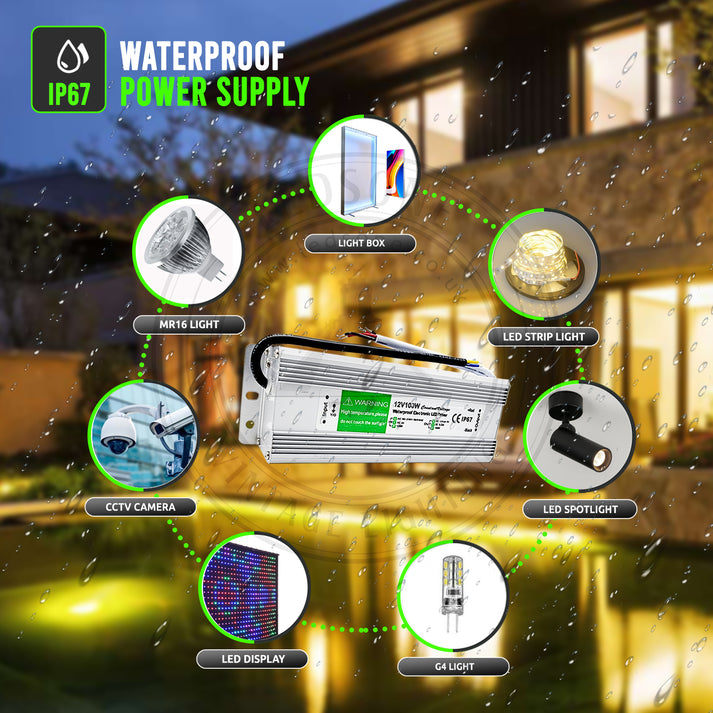
- IP67 — Protected against temporary submersion in water. Used in more demanding outdoor or underground cable runs.
- For any outdoor lighting project — whether that's garden path lighting, exterior wall illumination, or pergola LED strips — you need a properly rated waterproof transformer. Using an indoor-rated driver outdoors is a safety hazard and will almost certainly lead to premature failure.
- LEDSone stocks a dedicated range of waterproof LED transformers with IP65 and IP67 ratings, available in both 12V and 24V output, for outdoor and demanding indoor applications.
How to Calculate the Right Wattage for Your Transformer
Choosing the correct voltage is only half the equation. You also need to make sure your transformer has enough wattage capacity to power all of your LEDs — but not so much that you're overspending on unnecessary capacity.
Step 1: Find the wattage per metre of your LED strip
Your LED strip packaging or product listing will show the wattage consumption per metre — for example, 4.8W/m, 9.6W/m, or 14.4W/m.
Step 2: Multiply by the total length of your run
If you're installing 6 metres of a 9.6W/m strip:
6 metres × 9.6W = 57.6W total
Step 3: Add a 20% safety buffer
Never load a transformer to 100% of its rated capacity. Running at full load causes the driver to overheat, dramatically shortening its lifespan and potentially causing failure.
57.6W ÷ 0.8 = 72W minimum transformer capacity
In this example, you would choose an 80W or 100W transformer.
Step 4: Match the voltage
If your strip is rated at 24V, you must use a 24V transformer. If it's rated at 12V, you must use a 12V transformer. There is no compatibility between the two — fitting a 24V transformer to a 12V strip will immediately destroy your LEDs, and fitting a 12V transformer to a 24V strip will mean your lights simply won't power up.
Common Mistakes to Avoid
Even experienced installers occasionally get caught out by these avoidable errors:
- Mismatching voltages — This is the most common and most damaging mistake. Always double-check the voltage marked on your LED strip before ordering a transformer. Overvoltage will burn out your LEDs instantly. Undervoltage means nothing lights up.
- Underspecifying wattage — Buying a transformer that's too small for your total LED load will result in overheating, flickering, and premature failure. Always calculate properly and add the 20% buffer.
- Using an indoor transformer outdoors — Moisture ingress will destroy an IP20 driver rapidly and creates a genuine safety hazard. Always match the IP rating to the installation environment.
- Ignoring voltage drop on long runs — If you're stretching a 12V system beyond 5 metres without power injection, you'll see visible dimming at the far end. Either switch to 24V or inject power at multiple points along the run.
- Using old halogen transformers with new LED strips — Halogen transformers are not compatible with LED strips and will either fail to power them or damage them. Always use a dedicated LED transformer or LED driver designed for the purpose.
Quick Decision Guide: Which Transformer Do You Need?
Still unsure? Use this quick checklist:
Choose a 12V transformer if:
- Your LED strip is rated 12V (always check the label)
- Your run is 5 metres or shorter from a single feed
- It's a small domestic installation: under cabinet, shelf, wardrobe, headboard
- You want the simplest DIY setup
Choose a 24V transformer if:
- Your LED strip is rated 24V
- Your run is longer than 5 metres
- You're lighting a full kitchen, living room cove, staircase, or exterior space
- It's a commercial, hospitality, or professional installation
- You want better energy efficiency and reduced voltage drop
Choose a waterproof transformer if:
- Any part of the installation is outdoors
- It's in a bathroom, utility room, or kitchen area near a sink
- There's any risk of moisture or condensation
Choose a constant current driver if:
- Your LED product specifies an input current (mA or A) rather than a voltage
Final Summary: 12V vs 24V at a Glance
The short version: 12V for short runs and simple domestic projects. 24V for longer runs, professional installations, and better efficiency.
The longer version: voltage choice comes down to the length of your LED run, the scale of your project, and the environment you're installing in. Match the transformer voltage precisely to your LED strip voltage, calculate your wattage with a 20% buffer, choose the right IP rating for the location, and decide between constant voltage and constant current based on what your LED product requires.
Get those four things right, and your LED lighting will perform perfectly, last for years, and cost you far less to run than any alternative.
If you need help choosing the right transformer for your specific project, the LEDSone team is on hand — call us on 02477 220687, email sales@ledsone.co.uk, or browse the full range online with same-day dispatch on orders placed before 2pm.
FAQ
Q1: Can I use a 24V transformer with a 12V LED strip?+
No — never use a 24V transformer with a 12V LED strip. The overvoltage will instantly burn out your LEDs. Always match the transformer output voltage exactly to your LED strip's rated voltage. Check the label on your strip before ordering.
Q2: What's the difference between an LED transformer and an LED driver?+
They're the same thing with different names. "LED transformer" and "LED driver" both refer to the device that converts UK mains 230V AC power to the low-voltage DC power your LED strips or bulbs need. "LED power supply" is another common term for the same product.
Q3: Why are my LED strip lights dimmer at one end?+
This is caused by voltage drop — a common problem with 12V LED strips over long runs. The LEDs near the transformer receive full voltage, while those further away receive less power. Switching to a 24V system or injecting power mid-run (adding a second feed point) solves this issue.
Q4: Do I need a waterproof LED transformer for outdoor use?+
Yes. For any outdoor installation, you need a transformer rated IP65 or IP67. Standard IP20 indoor transformers will fail quickly when exposed to moisture and create a safety hazard. LEDSone stocks both 12V and 24V waterproof LED transformers suitable for garden, pergola, and exterior architectural lighting.
Q5: How do I calculate what wattage LED transformer I need?+
Multiply your LED strip's watts-per-metre by the total run length in metres. Then divide by 0.8 (add a 20% safety buffer). For example: 6m × 9.6W/m = 57.6W ÷ 0.8 = 72W minimum. Choose the next transformer size up — in this case, an 80W or 100W LED driver.
Q6: Can I use an old halogen transformer with LED strips?+
No. Old halogen transformers are not compatible with LED strips and will either fail to power them correctly or damage them over time. Always use a dedicated LED transformer or LED driver specifically designed for LED technology.
Labels:
Vorig
3 Pendant Lights Over a Kitchen Island: Size, Spacing, and Design Tips
Volgende
Dimmable LED Bulbs UK: What You Need to Know Before You Buy