Ceiling Rose Weight Limits: What You Need to Know Before Hanging a Light
Hanging a new pendant light or chandelier looks like a simple job — until you're stood on a stepladder wondering whether the little disc of metal or plastic on your ceiling can actually take the weight of the fitting in your hands. It's one of the most searched questions in UK home lighting, and for good reason: get it wrong, and the consequences range from a fitting slowly sagging out of its socket to a full ceiling failure.
This guide breaks down exactly how much weight a standard ceiling rose can hold, what UK wiring regulations actually require, the difference between what your flex cable can support and what your fixing point can support, and how to safely hang anything heavier than an everyday pendant — from a mid-size chandelier to a multi-arm statement piece.
Key Takeaways
- Most standard metal ceiling roses sold in the UK are rated to hold up to 5kg (11lbs), matching the minimum requirement set out in UK wiring regulations for pendant luminaire fixing points.
- The 5kg figure applies to the fixing point, not the flex cable — standard 0.5mm² flex can typically support around 2kg, while 0.75mm² flex can support around 3kg, so a heavy fitting needs both a rated rose and a suitable cable.
- Where and how the rose is screwed in matters as much as its weight rating. A rose fixed into a ceiling joist behaves very differently to one fixed only into plasterboard.
- Chandeliers, multi-arm fittings, and anything above roughly 3–4kg should use a hook-and-chain support system rather than relying on the electrical connection alone to bear the load.
- For anything heavier than the rated capacity of your rose, or if you're unsure what's above your ceiling, use a qualified electrician — this is a job where guessing is not worth the risk.
Why Ceiling Rose Weight Limits Exist
A ceiling rose does two jobs at once. It's the visible, decorative cover that finishes off the point where your lighting circuit meets the room, and it's also — in most standard installations — the mechanical anchor point that the entire pendant fitting hangs from. That dual role is exactly why weight limits matter.
Electrically, the terminals inside a rose are designed to carry current safely. They are not designed, on their own, to carry the physical mass of a fitting. If a heavy shade or chandelier pulls directly on those terminal connections rather than on a proper mechanical fixing, three things tend to happen over time: the wires slowly work loose, the connection becomes intermittent or dangerous, and eventually the fitting can detach completely.
This is exactly why UK wiring regulations specify a minimum weight capacity for the fixing means of a pendant light — not as a bureaucratic box to tick, but because ceiling fixtures genuinely do fail when this is ignored.
What UK Regulations Actually Say About Ceiling Rose Weight
The UK's national wiring standard, BS 7671, addresses this directly in its section on luminaire fixing. In simple terms, the regulation requires that wherever a fixing point is intended to support a pendant light fitting, that fixing point must be capable of safely carrying a mass of at least 5kg. If the actual fitting weighs more than that, the installer is responsible for making sure the fixing point can handle the extra load — and the fixing itself has to be installed following the manufacturer's instructions, taking into account what the ceiling structure underneath can actually bear.
This is why you'll see "5kg capacity" listed as the standard spec across almost every metal ceiling rose sold in the UK, including <cite index="33-1">most standard metal ceiling roses, including front-fitting models, which are designed to safely suspend loads up to 5kg (12lbs)</cite>. It's not an arbitrary marketing number — it's the baseline the regulations set for any pendant fixing point in a UK home.
Two important nuances worth understanding:
5kg is a minimum, not a universal maximum. A well-made, correctly installed heavy-duty rose can be rated well beyond 5kg — some heavy-duty roses and hooks on the market are tested to hold as much as 8kg. Always check the manufacturer's stated capacity for the specific product rather than assuming every rose is capped at exactly 5kg.
The rating applies to the rose and its fixing — not automatically to your ceiling. This is the part most people miss, and it's covered in detail below.


Ceiling Rose vs Flex Cable: Two Different Weight Limits
This is where a lot of confusion happens, because there are actually two separate weight limits at play in any pendant light installation, and both need to be respected.
1. The fixing point (the rose itself and its screws into the ceiling)
This is the 5kg figure discussed above — the mechanical anchor that takes the true structural load of the fitting.
2. The flex cable running from the rose to the lampholder
Even if your rose is rated for 5kg, the cable running through it has its own, much lower, weight tolerance. As a general guide used across the UK electrical trade, standard 0.5mm² flexible cable is considered suitable for loads up to around 2kg, while heavier-duty 0.75mm² flex can typically support up to around 3kg.
That means a lampshade weighing 3.5kg hanging purely on 0.5mm² flex is a real problem — even though the ceiling rose behind it is rated for 5kg. The cable, not the rose, becomes the weak link. This is exactly why manufacturers of heavier shades often print a direct instruction to check that the pendant wiring is rated for the shade's weight before installation.
The practical fix: for anything approaching or exceeding 2–3kg, don't let the flex carry the load at all. Use a proper strain-relief fitting inside the rose (most quality roses include lugs or a cord grip specifically for this), or better still, move to a chain-supported fitting where a metal chain — not the electrical flex — bears the physical weight, and the flex simply carries current alongside it.
Plasterboard vs Ceiling Joist: The Fixing Point That Actually Matters
A 5kg-rated ceiling rose is only as strong as what it's screwed into. This is the single most common mistake in UK homes, and it's a genuinely dangerous one.
Screwed into a ceiling joist: A rose fixed with proper wood screws directly into solid timber will comfortably carry its rated capacity, because the load is being transferred into a structural timber member designed to bear weight.
Screwed only into plasterboard: Plasterboard alone is not designed to carry concentrated point loads. Even a well-installed rose, if it's only anchored into plasterboard rather than a joist or a noggin (a short timber brace fitted between joists), risks the plasterboard itself failing under sustained weight — particularly once you factor in moisture, age, or vibration over years of use. Electricians who carry out periodic inspections regularly find ceiling roses that were fitted into plasterboard immediately next to an accessible joist, simply because it was quicker at the time.
If you don't know what's directly above your ceiling rose — timber joist, steel bracket, or just plasterboard — that's the first thing to establish before hanging anything heavier than a standard lightweight shade. In lofts or accessible ceiling voids, this is easy to check visually. In a mid-terrace flat with a sealed ceiling, it's a job for an electrician, who can locate joists and, if needed, fit a noggin or a load-spreading plate before the rose goes back up.
How Much Does Your Light Fitting Actually Weigh?
Before you can decide whether your ceiling rose is up to the job, you need a realistic number for what you're hanging. A few reference points:

| Fitting Type | Typical Weight Range |
|---|---|
| Simple fabric or paper lampshade | 0.2–1kg |
| Standard glass pendant shade | 1–2.5kg |
| Small metal or cage pendant | 1.5–3kg |
| Mid-size 3–5 arm chandelier (metal) | 3–6kg |
| Crystal chandelier, multi-tier | 6–15kg+ |
| Large statement/foyer chandelier | 15kg and well beyond |
It's worth weighing your fitting on a bathroom scale before installation wherever possible, rather than guessing. Manufacturers of quality lighting will list the product weight in the specification — if a supplier can't or won't tell you how heavy a chandelier is, that's worth treating as a warning sign rather than a minor omission.
Installing a Heavier Fitting Safely: Step by Step
If your fitting weighs more than the standard 5kg rating, or you're moving from a simple shade to a genuine chandelier, here's the practical sequence to follow:
- Weigh the fitting. Get an accurate figure, including the shade, arms, and any decorative crystal or glass elements — these add up quickly.
- Locate the ceiling structure. Identify whether there's a joist directly above the fixing point, or whether you'll need a noggin fitted between joists to create a solid anchor.
- Choose a rose or bracket rated above the fitting's weight, with a safety margin — don't fix a 5kg-rated rose to a 4.8kg chandelier and call it done.
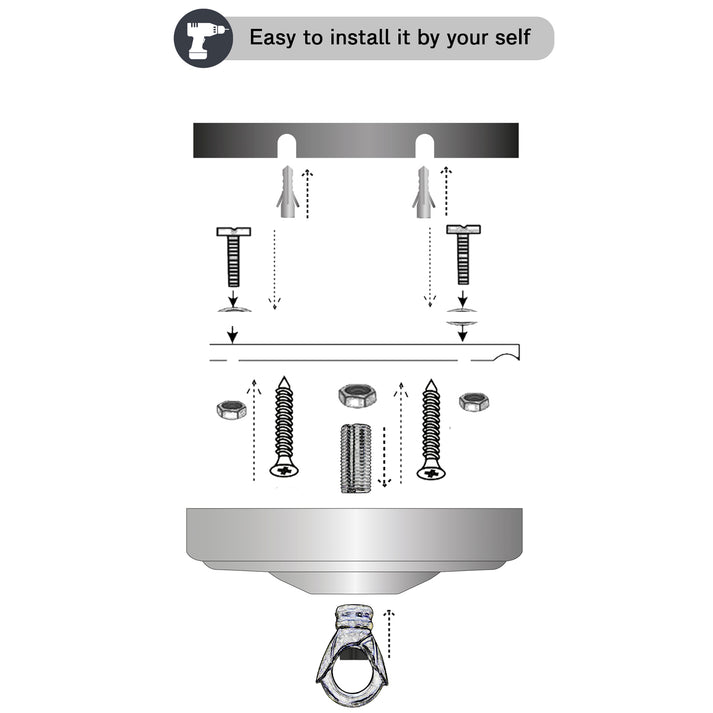
- Separate the mechanical load from the electrical connection. Use a hook-and-chain or bracket system so the physical weight is carried independently of the flex and terminal connections.
- Fit strain relief for the flex regardless of the mechanical support, so vibration or minor movement never puts tension on the wired terminals.
- For anything above roughly 8–10kg, or where you're unsure about the ceiling structure, bring in a qualified electrician rather than completing the installation yourself. This is a case where reinforcement — additional timber blocking, a spanning bracket, or in extreme cases a dedicated structural fixing — genuinely is required, not optional.
Signs Your Current Ceiling Rose Is Under Strain
If a fitting is already installed and you're not sure whether it's within safe limits, look out for:
- Visible sagging or a slight downward tilt of the rose over time
- Hairline cracks radiating from the rose in the surrounding ceiling surface
- A fitting that sways or feels loose when gently touched
- Any fitting currently hanging only from its wiring after a rose has come loose (this should be treated as an immediate hazard, not a maintenance item for later)
Any of these are reasons to stop using the fitting and have it inspected before continuing.


Ceiling Rose Materials: Does It Affect Weight Capacity?
Not all ceiling roses are built the same, and material plays a real role in how much confidence you should place in the stated weight rating.
Metal ceiling roses (typically plated iron or steel) are the standard choice for anything beyond the lightest fittings. They flex less under load, distribute stress more evenly across their fixing screws, and are the material of choice for the 5kg-and-above ratings discussed throughout this guide. Riveted construction, rather than simple pressed-metal seams, tends to hold up better over years of use.
Plastic or resin ceiling roses are common in budget new-build installations and are perfectly adequate for lightweight fittings — a small paper shade or a basic bulb holder. They are not the right choice once you're hanging anything with real mass, since the material itself can creep or crack under sustained load, particularly in warmer rooms where plastic softens slightly over time.
Traditional plaster or period-style roses found in older UK properties are often decorative only, with the actual electrical and mechanical fixing hidden behind or independent of the ornamental plasterwork. If you have an original Victorian or Edwardian plaster rose, don't assume it's your structural fixing point — in most cases a separate metal batten or ceiling box does the real work, and the plaster rose is purely cosmetic.
If you're restoring a period property and want to keep an original decorative rose while safely hanging a heavier modern fitting, the usual approach is to fit a discreet metal fixing point behind or through the centre of the plaster rose, so the visual character is preserved while the actual load path runs through a properly rated component.
Common Mistakes People Make With Ceiling Rose Weight
After looking at how ceiling roses actually fail in practice, a handful of mistakes come up again and again:
Assuming "5kg" means the whole system is rated to 5kg. As covered above, the rose might be rated for 5kg while the flex is only good for 2–3kg. The lowest-rated component in the chain is what actually matters.
Fixing into the nearest convenient spot rather than a joist. It's common for an existing rose to have been screwed into plasterboard next to a joist simply because it lined up with where the previous fitting sat. When installing a heavier replacement, it's worth relocating the fixing to land directly on solid timber rather than preserving the old position purely for convenience.
Relying on the shade's decorative arms or frame to bear weight it wasn't designed for. Some multi-arm fittings distribute weight across their frame in ways the manufacturer has engineered for; others genuinely rely on a single, central chain point. Always follow the manufacturer's specified hanging method rather than assuming a fitting can be rigged however looks best.
Skipping the accessible-loft check. If you have loft access above the room in question, checking joist position and condition takes minutes and removes almost all the guesswork before you even pick up a drill.
Ignoring visible warning signs because "it's been like that for years." A ceiling rose that has held for a decade isn't proof it's correctly fixed — plasterboard and old adhesive-based fixings can hold for a surprisingly long time before failing suddenly rather than gradually.
When to Upgrade Your Ceiling Rose Before Adding a New Light
It's worth treating any change of light fitting as a natural checkpoint to reassess your ceiling rose, not just swap the shade and move on. Consider upgrading the rose itself if:
- You're moving from a simple pendant to any style of chandelier, however small
- The existing rose shows any of the strain signs covered earlier in this guide
- You don't know the age or rated capacity of the current rose, particularly in a property you've recently moved into
- You're combining multiple elements — cage bulb, braided cable, decorative holder — into a heavier finished assembly than the room's original fitting
A new, correctly rated rose is a genuinely inexpensive part of any lighting project relative to the fitting it's supporting, and it removes the single biggest unknown in the entire installation.
FAQs
How much weight can a standard ceiling rose hold?+
Most standard metal ceiling roses sold in the UK are rated to support up to 5kg, which matches the minimum requirement under UK wiring regulations for pendant light fixing points. Heavy-duty ceiling roses may support up to 8kg or more, but always check the manufacturer's specified load rating.
Is 5kg the maximum weight for any ceiling light in the UK?+
No. There is no fixed legal maximum weight for ceiling light fittings in the UK. While standard fixing points are designed for a minimum of 5kg, heavier light fittings can be installed safely if the ceiling structure, fixings, and cable support are upgraded appropriately by a qualified electrician.
Can my ceiling rose hold a chandelier?+
It depends on the chandelier's weight and how the ceiling rose is mounted. Smaller chandeliers weighing under 5kg can often be supported by a standard ceiling rose fixed into a joist. Larger or heavier chandeliers usually require a heavy-duty ceiling rose or mounting bracket, a chain support system, and a ceiling structure capable of supporting the additional weight.
What happens if my light fitting is heavier than the flex cable rating?+
If the light fitting exceeds the flex cable's mechanical load rating, the cable can become the weak point. Over time, the weight may pull the conductors from their terminals, creating both mechanical and electrical safety risks. Heavy fittings should be supported by a chain or mounting bracket, with the flex cable carrying only electrical current.
Do I need an electrician to hang a heavy light fitting?+
Yes, for light fittings exceeding the standard 5kg support rating or whenever you are unsure of the ceiling structure. A qualified electrician can assess the ceiling, install reinforcement if required, and ensure the fitting is safely supported and complies with UK electrical regulations.
Choosing the Right Ceiling Rose for Your Fitting
Whether you're finishing a simple pendant or building a full custom chandelier setup, matching the rose to the job is the part that actually keeps everyone safe:
- Standard single-outlet ceiling roses — ideal for everyday pendants and lightweight shades up to the standard 5kg rating.
- Multi-hole and rectangular ceiling roses — designed for pendant clusters or multi-light arrangements, useful where several lighter fittings share one fixing point rather than one heavy load on a single rose.
- Heavy-duty roses and brackets with hook-and-chain support — the right choice once you move into chandelier territory, keeping the mechanical load entirely separate from the wiring.
If you're planning a full vintage or industrial-style pendant build — combining a cage bulb, braided fabric cable, and a ceiling rose — the weight principles above still apply directly: check your rose's rated capacity, confirm what it's fixed into, and make sure the cable you choose is rated for the finished assembly, not just the bulb on its own.
Final Thought
A ceiling rose might be one of the smallest, least glamorous parts of any lighting setup, but it's doing genuine structural work every hour of every day. The 5kg standard exists because it reflects real-world regulation, not guesswork — and the moment you go beyond a simple lightweight pendant, the rules of the game change: you're no longer just choosing a rose for looks, you're choosing a fixing system for the specific weight, cable, and ceiling structure in front of you. Get those three things right, and there's no reason a beautiful, heavier fitting can't be installed safely and left up for decades.
This article is provided for general guidance. For any installation involving a fitting heavier than standard, an uncertain ceiling structure, or existing wiring you're not confident about, always consult a qualified electrician to ensure the work meets current UK wiring regulations.
Tags:
Previous
Steampunk & Pipe Lighting Ideas for Industrial-Style Homes 2026
Next
Single Pendant vs Cluster: Which Is Right for Your Kitchen Island in 2026?