Single Vs Cluster Pendant Lights: Which Works Best in Each Room?
The Simple Truth About Pendant Lights
Most UK homes get pendant lighting wrong in one of two ways. Either there is a single small pendant in the middle of the ceiling doing nothing useful, or someone has crammed three matching pendants over a kitchen island that is too small for them.
Single pendant lights and cluster pendant lights are not interchangeable. They serve different rooms, different ceiling heights, and different purposes. Get the match right and the room looks intentional and well-lit. Get it wrong and no amount of paint colour or furniture will fix the feeling that something is off.
This guide tells you exactly which to choose, room by room, with no padding.
What Is a Single Pendant Light?
A single pendant light is one hanging fixture suspended from one ceiling rose on one cable. It has one light source — either a bare bulb, a bulb inside a shade, or an integrated LED.
Single pendants work best when:
- You need a focal point above one defined spot — a small dining table, a reading chair, a bedside position
- The ceiling area is compact and a cluster would feel crowded
- You want a bold, oversized statement piece that fills the space on its own
- The room is small (under 15m²) and one well-placed fitting is all it needs
What Is a Cluster Pendant Light?
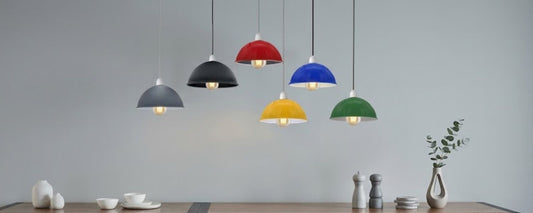
A cluster pendant light (also called a spider pendant light, multi-drop pendant, or spider light) has multiple individual bulbs or shades hanging from one central ceiling canopy or rose.
There are two main types:
Spider lights — A single canopy with multiple arms or cables. LEDSone's spider pendant range includes 2-head, 3-head, 4-head and 5-head configurations. Each cable is independently adjustable so you can set uniform drops or staggered heights without additional wiring.
Separate pendants in a group — Multiple individual pendant holders installed from separate ceiling roses in a planned arrangement. More installation work, more flexibility in exact positioning.
Single vs Cluster: Head-to-Head Comparison
| Single Pendant | Cluster / Spider Pendant | |
|---|---|---|
| Number of bulbs | 1 | 2–8 |
| Light spread | Focused, one area | Wide, distributed |
| Best ceiling height | Standard 2.4m+ | Standard to high |
| Best room size | Small to medium | Medium to large |
| Installation | One ceiling rose, simple | One rose (spider) or multiple |
| Visual effect | Clean, bold, singular | Sculptural, layered, dynamic |
| Adjustable drops | Fixed at installation | Yes — spider lights allow adjustment |
| 2026 trend rating | ★★★★☆ | ★★★★★ |
| Works with dimmer? | Yes | Yes |
| Average price range | £15–£200 | £20–£300 |
Room-by-Room: Single or Cluster?
Kitchen Island
Use a cluster. Almost always.
A single pendant light over a kitchen island only works if the island is under 80cm wide. One light source in the centre leaves both ends of the worktop in shadow — the area where you actually chop, prep, and plate.
The rule is simple:
| Island Width | Pendants Needed | Spacing |
|---|---|---|
| Under 80cm | 1 single pendant | Centred |
| 80–120cm | 2 pendants | 40–50cm apart |
| 120–160cm | 2–3 pendants | 40–50cm apart |
| 160–200cm | 3 pendants | 65–80cm apart |
| Over 200cm | 3–4 pendants | 70–80cm apart |
Hang the bottom of each shade 70–80cm above the worktop surface. Lower than this and you block the sightline across the island. Higher than this and the light spreads too wide to be useful for task lighting.
The cleanest solution for a UK kitchen island is LEDSone's 2-head or 3-head spider pendant light — one ceiling connection, independently adjustable cables, evenly spaced drops. No extra wiring, no alignment guesswork.
For smaller islands where you want a genuine statement single pendant, choose a shade of at least 30–45cm diameter so it fills the visual space above the worktop properly.
Pair all island pendants with dimmable E27 warm white bulbs at 2700K–3000K — bright enough for prep, warm enough for evenings.
Dining Room
Single for small round tables. Cluster for large or rectangular tables.
The dining table is the most classic pendant light location in UK homes. The choice depends on two things: table shape and table length.
| Dining Table Type | Best Style | Pendant Size / Count |
|---|---|---|
| Round, up to 100cm | 1 large single pendant | 40–50cm diameter shade |
| Square, up to 100cm | 1 single pendant or small 3-drop cluster | Shade diameter = ½ table width |
| Rectangular, 120–160cm | 2 pendants or 3-head spider | Space evenly along length |
| Rectangular, 160–200cm+ | 3-head or 5-head spider pendant | 60–70cm between each drop |
| Open-plan dining zone | 3–5 drop spider pendant | Cover full table length |
Hang dining pendants 70–80cm above the table surface. This height puts light directly onto the food and faces without blocking conversation across the table.
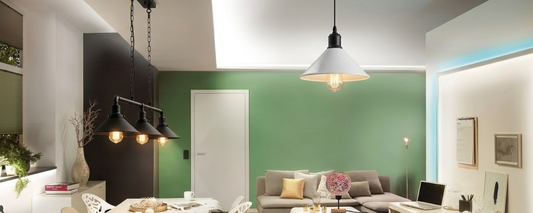
For a round table, a single oversized pendant — a large glass globe, a wide dome, or a statement geometric shade — centred directly above is the strongest choice. For a rectangular table over 120cm, a 3-head or 5-head spider pendant with adjustable drops covers the full length of the table and creates far better light distribution than one central fitting.
Use dimmable pendant bulbs in every dining fitting. The ability to dim from full family-dinner brightness down to an intimate 30% for evening entertaining is one of the most worthwhile lighting features in any home.
Living Room
Single for rooms under 20m². Cluster for large or open-plan spaces.
The living room has the widest range of lighting needs of any room — bright for reading, dimmed for films, atmospheric for evenings. A single central pendant rarely meets all of these unless it is large, well-chosen, and paired with additional floor and table lamps.
When a single pendant works in a living room:
- Room under 20m²
- Pendant hung above a coffee table or seating area as a defined focal point
- Supported by wall lights and table lamps for full layered coverage
When a cluster pendant works better:
- Open-plan living space above 20m²
- High ceilings (2.7m+) where one pendant looks lost
- Loft conversions, double-height rooms, or wide open spaces where the cluster fills vertical space
- Rooms where you want the lighting itself to be the design statement
LEDSone's 4-head and 5-head spider pendants with 195cm adjustable cables are designed exactly for large living spaces — you can set three drops at one height and two shorter to create a sculpted, asymmetric arrangement without any rewiring.
In living rooms, use 2700K warm white vintage filament bulbs inside any pendant. The warm amber glow from an exposed filament bulb inside a glass shade is the most atmospheric living room lighting choice available in 2026.


Bedroom
Single pendants as bedside lights. Spider pendant for a master bedroom statement.
The most significant shift in bedroom lighting in UK homes in 2026 is the move from bedside table lamps to bedside pendant lights — single pendants hung either side of the bed, each from its own ceiling rose, at a drop height of around 120–130cm from the floor (reading height).
This creates a cleaner bedside aesthetic, frees up table surface space, and allows very precise positioning of the light relative to where you actually read.
| Bedroom Scenario | Recommended Style |
|---|---|
| Bedside reading light (each side) | 1 single pendant per side |
| Small bedroom (main ceiling) | 1 single pendant |
| Large master bedroom (main ceiling) | 3-head spider pendant |
| Hallway off bedroom / landing | 1 single pendant |
For the main ceiling fitting in a large master bedroom, a 3-head spider pendant hung centrally above the bed with drops set at varying heights creates an immediate sense of considered, designed space.
Always use dimmable LED bulbs at 2700K in bedroom pendants. Dimmability is not optional in a bedroom — it is the feature that makes the room functional from early morning brightness to near-darkness for sleep.
Hallway and Entryway
Single pendant for narrow halls. Spider pendant for grand or double-height spaces.
The hallway sets the first impression of a home. It is almost always under-lit and under-designed.
Narrow hallway (under 120cm wide): One single pendant centred at a minimum clearance of 210cm from the floor. Keep the shade diameter under 25cm to avoid visual crowding. A vintage glass pendant in amber or smoked glass adds warmth immediately.
Wide hallway or double-height entryway: A spider pendant light with 3–5 drops at staggered heights fills the vertical space and creates an immediate statement. In period properties with high ceilings, a cluster with drops at varying lengths draws the eye upward and makes the height feel intentional rather than empty.
For hallways with multiple ceiling positions along a corridor, two individual pendants spaced 2–3 metres apart give far better coverage than one central fitting — and a more considered look.
Home Bar, Café Style and Entertaining Spaces
Cluster pendants. No exceptions.
The industrial cluster pendant aesthetic that defines bars, restaurants, and cafés has moved into UK homes as a mainstream interior choice in 2026. Multiple spider pendant lights hung above a home bar area, kitchen-diner, or entertaining space creates exactly the warm, ambient, layered atmosphere that makes hospitality spaces feel so inviting.
LEDSone's 5-head spider pendant with geometric cage shades paired with vintage Edison filament E27 bulbs is the definitive 2026 industrial-vintage home bar setup. The raw cage shades expose the warm filament glow; the multi-drop arrangement creates depth and visual interest across the space.


The 5 Most Common Pendant Light Mistakes in UK Homes
Drop Height Quick Reference
| Location | Correct Drop Height |
|---|---|
| Kitchen island | 70–80cm above surface |
| Dining table | 70–80cm above table surface |
| Living room above seating | 150–160cm from floor to bulb |
| Hallway / corridor | Min. 210cm clearance from floor |
| Bedroom (central) | Min. 200cm clearance from floor |
| Bedside pendant | 120–130cm from floor |
| High ceiling / stairwell | Adjust to balance — min. 200cm clearance |
For plug-in installations with no ceiling wiring required, browse LEDSone's plugin pendant lights — ideal for renters or anyone who wants a pendant without an electrician.


Bulb Guide for Pendant Lights
| Room | Colour Temp | Lumen Output | Bulb Type |
|---|---|---|---|
| Kitchen island | 3000K | 600–800 lm per pendant | Dimmable E27 |
| Dining room | 2700K | 600–800 lm | Dimmable E27 or filament |
| Living room | 2700K | 800–1000 lm | Dimmable E27 or filament |
| Bedroom (main) | 2700K | 600–800 lm | Dimmable E27 |
| Bedside pendant | 2700K | 300–450 lm | Dimmable E27 |
| Home bar / café | 2700K | 400–600 lm per head | Vintage filament E27 |
| Hallway | 2700K–3000K | 600–800 lm | E27 or B22 |
Frequently Asked Questions
Q: What is a cluster pendant light?+
A cluster pendant light has multiple individual bulbs or shades hanging from one central canopy. A spider pendant light is the most common version — a single ceiling fitting with 2–6 adjustable cable drops. The result is wide, distributed light with a sculptural, layered appearance. Browse LEDSone's spider pendant light range.
Q: How many pendant lights do I need over a kitchen island?+
One pendant per 60–80cm of island length, minimum two for any island over 80cm wide. A 120cm island takes 2 pendants; a 160cm island takes 3. Hang them 70–80cm above the worktop, spaced evenly. A 2-head or 3-head spider pendant from LEDSone handles this from a single ceiling connection.
Q: What is the difference between a spider light and a chandelier?+
A spider pendant light has multiple arms or cable drops from one canopy, each holding one bulb — raw, industrial, and contemporary in aesthetic. A chandelier has an ornate decorative frame — traditional, formal, and decorative. Spider lights suit industrial, vintage, and modern interiors; chandeliers suit classical or glamorous rooms.
Q: Can a spider pendant light work on a standard 2.4m ceiling?+
Yes. LEDSone's spider pendant lights have 195cm adjustable cables. Set the drops to 40–60cm for a standard ceiling — plenty of adjustability. The ceiling hooks included with the 4-head and 5-head models allow excess cable to be managed cleanly.
Q: What bulbs should I use in pendant lights?+
Use dimmable E27 LED bulbs at 2700K for living rooms, dining rooms, and bedrooms. Use 3000K for kitchen island task lighting. For any pendant where the bulb is visible — open cage shades, clear glass pendants — use vintage filament bulbs at 2700K for the warmest, most atmospheric result.
Q: Do I need an electrician to install a spider pendant light?+
For hardwired installations, yes — connection to the mains ceiling supply should be done by a qualified electrician. For a no-wiring alternative, LEDSone's plugin pendant lights plug into a standard UK wall socket and require no ceiling wiring at all.
Q: Should all shades in a cluster match?+
Matching shades give a clean, cohesive, designed result — ideal for kitchens and dining rooms. Mixed shades on a spider pendant create an eclectic, artistic arrangement — great for living rooms and home bars. LEDSone's 5-head industrial spider pendant comes with five different shade styles in one fitting, making a curated mix easy.
Q: What is the best pendant light finish for 2026?+
Brushed brass and matte black are the two dominant finishes in UK pendant lighting in 2026. Brushed brass suits warm, layered interiors with wood tones and amber glass. Matte black suits industrial and contemporary kitchens with concrete or stone surfaces. Both are available across LEDSone's spider pendant light range.
Shop at LEDSoneFree UK delivery on orders over £25. Same-day dispatch on orders placed before 2pm.Call 02477 220687 or email sales@ledsone.co.uk for help choosing the right pendant for your space.
Tags:
Previous
Conduit Lighting: The Exposed Pipe Look That's Taken Over UK Interiors (2026 Guide) | LEDSone
Next
How to Wire a Ceiling Rose: Step-by-Step Guide for UK Homes